Our product
PretCarburant
Petrol, diesel and LPG prices in 6 countries, refreshed every 2 hours.

Card payments, subscriptions and paid API plans on Stripe, built so that every payment, renewal and cancellation is recorded correctly in your system.
Start a projectOur Stripe integration services cover card checkout, subscriptions and billing for paid APIs, including the part buyers never see: what your system does after each payment event. We use Stripe in our own work. PretCarburant sells paid API plans with payments handled by Stripe, next to a free public API.
The payment form is only the visible part. A complete integration has several pieces:
The usual trouble in a payment system is the gap between money and access: a customer who paid and cannot log in, or one who cancelled and still can. That is why webhook handling gets as much attention as the payment page.
With Stripe, payments go to the Stripe account of the business that sells, and from there to its bank account. The integration only connects your product to that account.
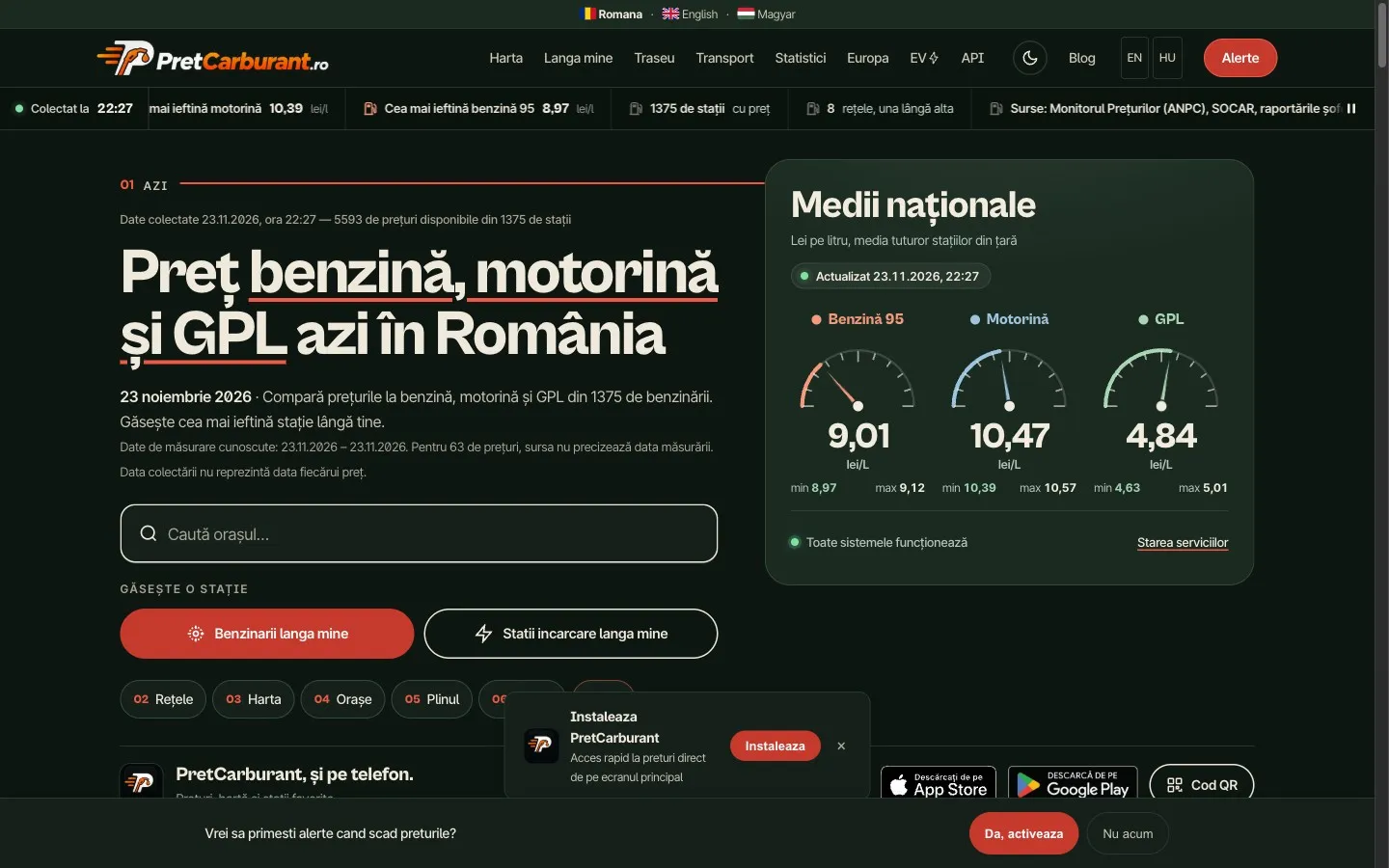
PretCarburant publishes fuel prices for stations in 6 countries. The same data is open to businesses through a free public API, and through paid API plans billed through Stripe. Everything needed to sell access to data is in place: the API, the plans, the payment and a public status page that shows whether the service is up. Every release has to pass 11,874 automated tests.
Corner4Candles is an online store we built and operate for a handmade candle brand. Today the store takes cash on delivery. Card payments through Stripe are built and can be switched on, with no new development, when the brand wants them. Its 435 automated tests exist because a checkout bug costs orders.
Selling access to data is a pattern we are repeating: HartaFarmacii, our pharmacy map and medicine price platform, has a paid API for businesses that is launching.
In the free initial analysis we write down what you sell and what must happen after each event. Is it a one-off payment, a subscription or access to an API? What should a customer get the second a payment succeeds? What happens when a renewal fails, or when someone cancels halfway through a month? The answers define the work far more than the payment page does.
You then get a fixed price for the project, before any work starts. We build the integration in a Stripe sandbox, Stripe’s test environment, where payment scenarios can be played through with test cards and no real money moves, and we cover the scenarios with automated tests. Live payments are switched on once those scenarios pass. After the final payment the source code is yours, and monthly maintenance is optional.
Stripe charges its own fees for processing payments. You pay them to Stripe, not to us, and the current amounts are on Stripe’s official pricing page. How we set our own price is explained on the pricing page.
Stripe handles the payment itself. What we write is the code around it, and that code lives on the server, never only in the browser: a payment is confirmed by Stripe’s webhook, not by the page the customer lands on afterwards. In our API products the server code is Python and Flask. In Corner4Candles it is Next.js and TypeScript, with orders kept in SQLite and emails sent through Resend.
Each webhook carries a signature, and the integration checks it before trusting the message. Events can arrive twice or out of order, so each handler is written to give the same result if it runs again. These details are invisible when everything works. They are what keeps your records right when something goes wrong.
Companies that own useful data and want to sell access to it through a paid API. Web applications that need subscriptions with several plans. Online stores that want card payments next to cash on delivery, a case we cover on our e-commerce website development page. And companies abroad looking for Stripe developers who also build the product around the payment.
Stripe is one part of our data, APIs and integrations work, and it usually sits inside a web application with accounts and plans. Tell us what you want to sell and how your customers should pay, and we will start with the free initial analysis. You can write to us from the contact page.
Updated C&S Visionary Systems team
Yes. PretCarburant sells paid API plans with payments handled by Stripe, next to a free public API. The same structure of plans, renewals and access rules works for a subscription to a web application.
Not with Stripe's hosted checkout or its payment form. The customer enters the card details on Stripe's side, and your system only receives the result of the payment.
Yes. In Corner4Candles, an online store we built and operate, Stripe card payments are built in and ready to switch on, while orders currently use cash on delivery.
Each project has a fixed price, set after a free initial analysis of what you sell and what has to happen after each payment. Stripe's own fees are separate: you pay them to Stripe, and the current amounts are on Stripe's official pricing page.
You own it. The source code becomes yours after the final payment, and payments go to your own Stripe account. Monthly maintenance after launch is optional.
Tell us about it. The first analysis is free and you get a fixed price before any work starts.
Start a project