Our product
PretCarburant
Petrol, diesel and LPG prices in 6 countries, refreshed every 2 hours.

One React Native codebase for Android and iOS when that is the right call, and a plain answer when native Kotlin or SwiftUI would serve you better.
Start a projectReact Native app development gives you one codebase that runs on both Android and iOS, and C&S Visionary Systems builds with it when that is the right call for the project. Our proof is PretCarburant for Android: an app we built and run, written in React Native with Expo and MapLibre maps, and live on Google Play. We also build native apps in Kotlin and SwiftUI, so our recommendation starts from your project, and sometimes the answer is not React Native.
React Native is an open-source framework for writing a mobile app once, in JavaScript or TypeScript, and running it on Android and iOS. The screens are drawn with each platform’s own interface components, not inside a web page, so the app looks and scrolls the way people expect. Expo is a set of tools built around React Native. It takes care of builds, updates and access to phone features such as location and notifications.
With the two we build cross-platform apps made mostly of data screens: maps, lists, search, forms, accounts, alerts and calculators, in several languages.
One codebase usually makes sense when:
It usually does not when:
Many projects sit in between: a cross-platform app with a few native parts, which we can write because we also work in Kotlin and SwiftUI.
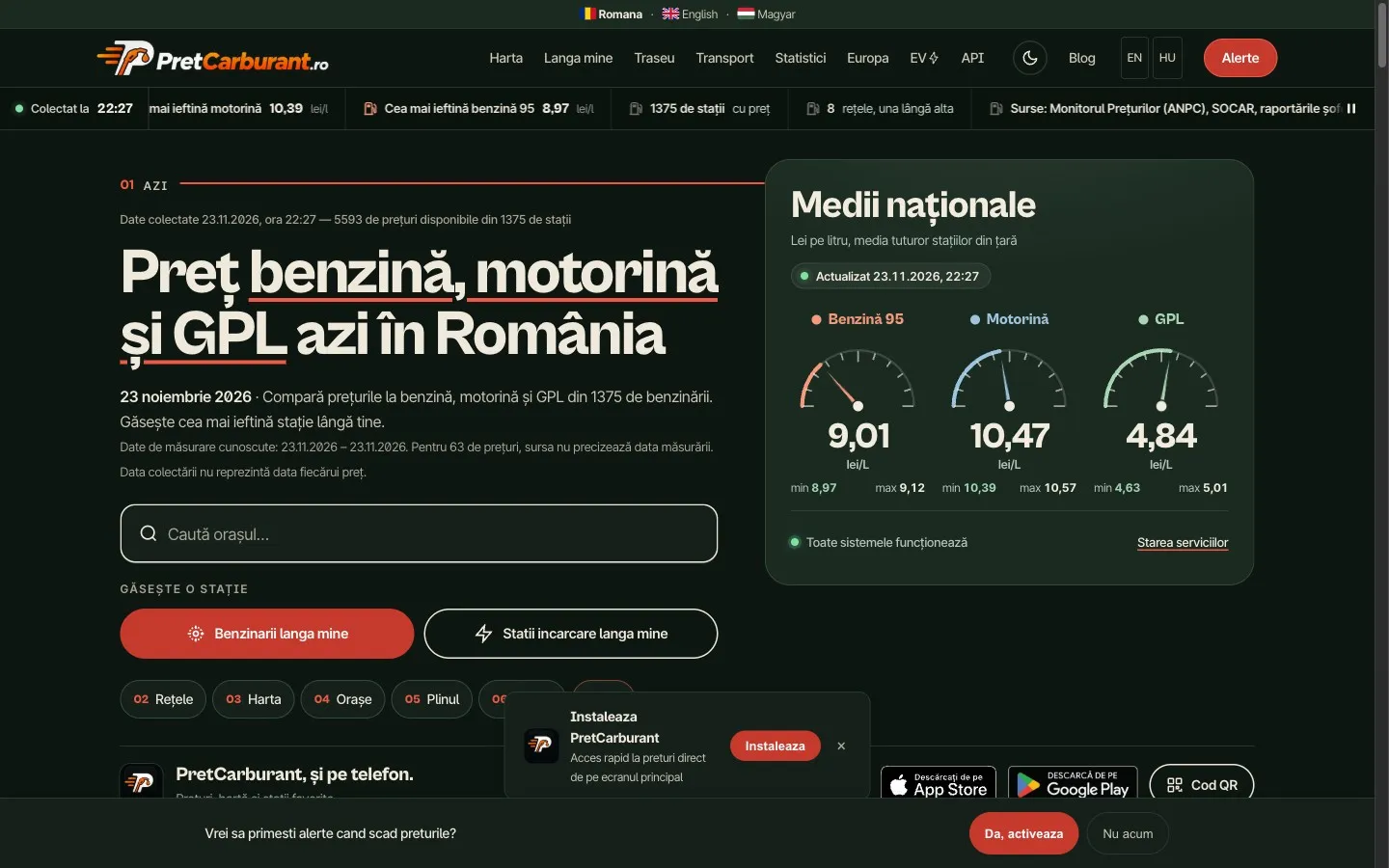
PretCarburant tracks petrol, diesel and LPG prices at stations in six countries, including about 1,500 in Romania, 2,038 in Bulgaria, 1,154 in Hungary and 615 in Moldova. Automated collectors refresh the prices every 2 hours, and drivers can report prices, set price-drop alerts and work out what a trip will cost. Its Android app runs on React Native and Expo, with MapLibre maps, and is live on Google Play in Romanian, English and Hungarian. No release goes out before 11,874 automated tests have passed.
We are just as open about where we chose native. The iOS app of the same product is native SwiftUI with a home-screen widget, and it has been submitted to the App Store. HartaFarmacii for Android is native Kotlin with Jetpack Compose. Our recommendation rests on running both approaches in production.
The free initial analysis answers the main question first: React Native or native. We go through your feature list, mark what the shared code covers and what would need native work, and tell you what we recommend and why. If the answer is native, we say so, and that work is described under Android app development and iOS app development.
Then comes the fixed price, set for the whole project before any work starts. We build the app with automated tests and check it on both platforms, because shared code can still behave differently on each.
One codebase still means two stores. Google Play and the App Store each have their own listing, rules and review, and we prepare both submissions. After the final payment you own the code: one codebase, not two. Monthly maintenance is optional and covers new versions of Android, iOS, React Native and Expo, plus fixes and new features.
What an app costs depends more on its features than on the framework. Our pricing page explains what moves the price.
The shared code is React Native with Expo. Maps are drawn with MapLibre, the open-source library behind the station map in PretCarburant for Android. Where a feature needs native code, we write it in Kotlin on Android and in Swift on iOS, with SwiftUI for interface parts.
Both platforms then talk to one backend, which is our job too, within the same mobile app development service. Our own backends run on Python and Flask.
Choose this route if you need Android and iOS at the same time and do not want the same screens built twice, or if you have a website or web platform and want apps on top of its API. It also suits teams weighing a React Native development agency against a native studio: with us that choice comes after the analysis, not before, because we do both.
As a React Native app development company in Bucharest, Romania, we give every client the same terms: a free initial analysis, a fixed price before work starts, and code that is yours after the final payment. Send us your feature list through the contact page, and we will tell you whether React Native fits.
Updated C&S Visionary Systems team
Usually yes when the app is mostly screens, lists, forms, maps and data from an API, and it has to reach Android and iOS together. It is a weaker fit when the app asks a lot of the device or needs new system features on the day they appear. You get our recommendation after the free initial analysis.
Yes. PretCarburant for Android is built with React Native, Expo and MapLibre and is live on Google Play, in Romanian, English and Hungarian.
Yes. HartaFarmacii for Android is native Kotlin with Jetpack Compose, and both of our iOS apps are written in SwiftUI. That is why we can recommend either approach.
The price is fixed and agreed before work starts, after a free initial analysis. It depends more on the app's features than on the framework, which is why we do not publish a price list.
You do, after the final payment. React Native is open source, so your own developers can take the code forward, and monthly maintenance from us stays optional.
Tell us about it. The first analysis is free and you get a fixed price before any work starts.
Start a project