Our product
HartaFarmacii
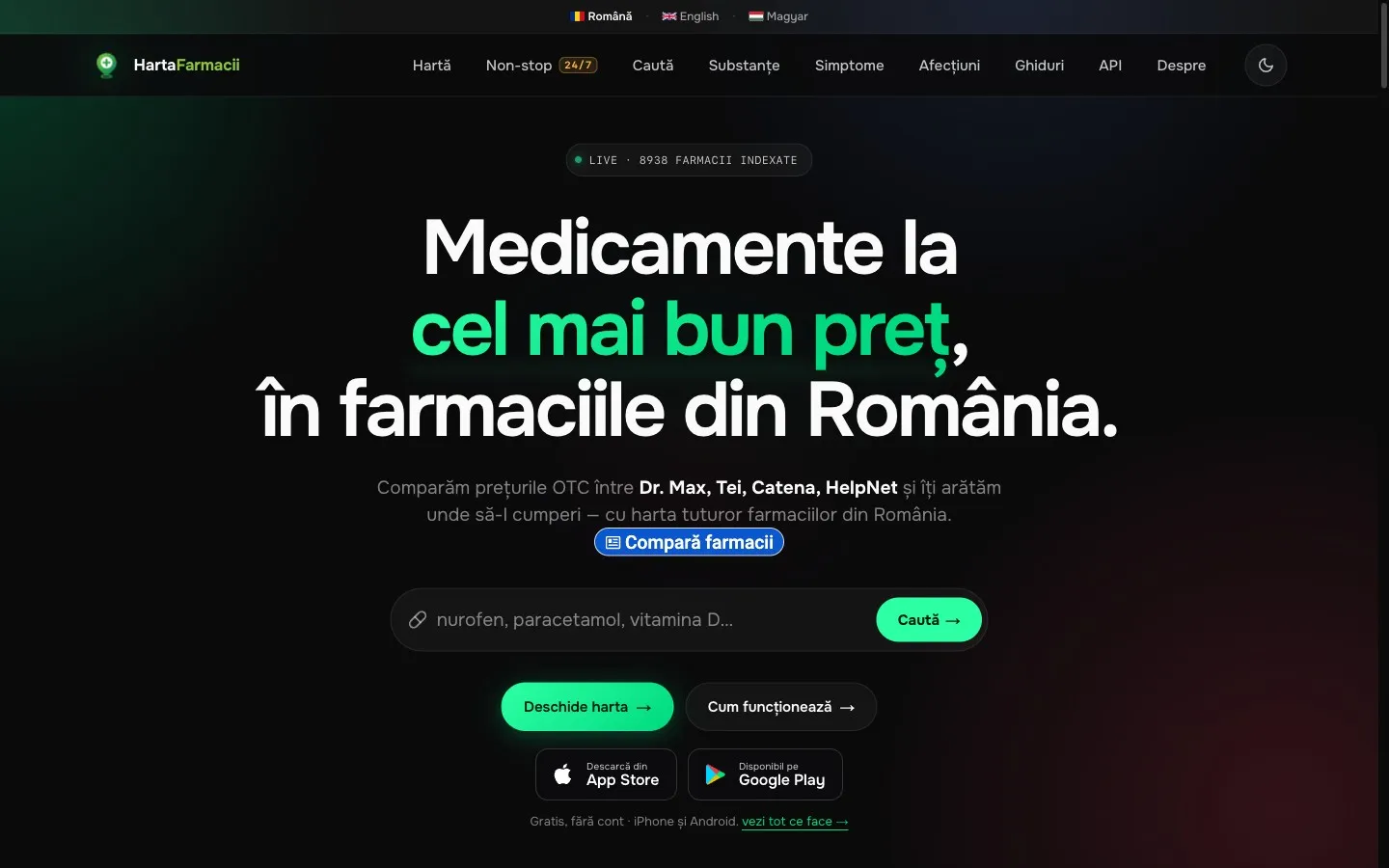
8,937 pharmacies on a map, with on-duty hours and prices compared across chains.

Platforms that collect prices from many sellers, keep them current and show the same product side by side, on the web and in apps.
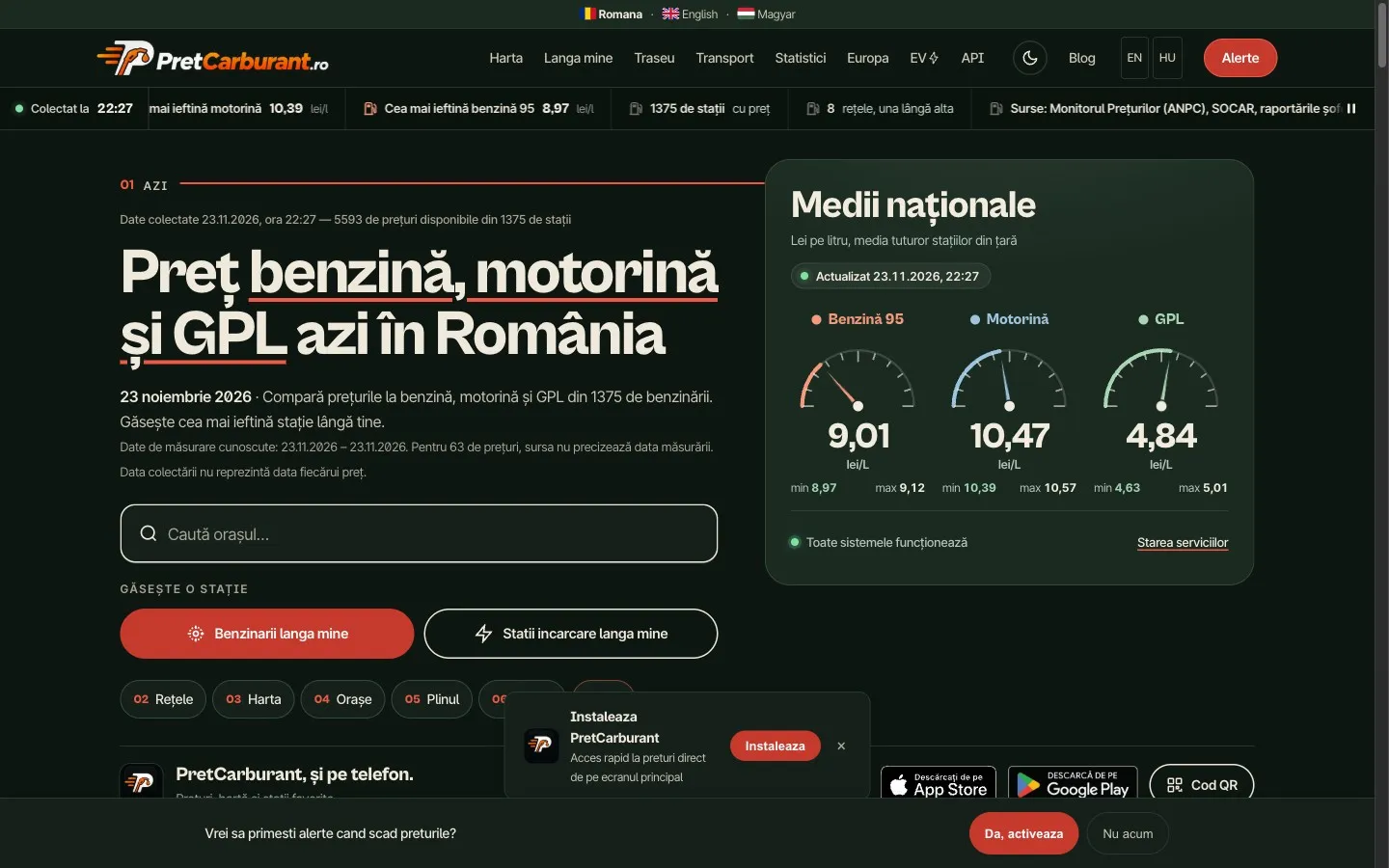
Start a projectAt C&S Visionary Systems we do price comparison website development, and we build the apps that go with it: platforms that collect prices from many sellers, keep them current and show the same product side by side. Our strongest proof is HartaFarmacii, a product we built and run: it shows a live price for 85,568 products and compares the same product from one pharmacy chain to the next. PretCarburant does the same for fuel, with prices from six countries refreshed every 2 hours.
The page a visitor sees is the small part. A comparison is worth using only if two things hold behind it: the prices are current, and the products being compared are the same product.
Keeping prices current is price tracking at scale. Every source gets its own collector, which runs on a schedule set by how fast that market moves. Each price is stored with its source and the time it was read, so the platform knows how old it is and can stop showing a stale one. A collector can fail quietly when a source changes its pages, so we add checks that notice when it returns too few products or prices that make no sense.
Keeping prices comparable is harder. Sellers name the same product in different ways, sell it in different pack sizes and do not always publish a common code. A comparison platform needs matching rules that link those listings to one product, and a place where uncertain matches wait for a person to confirm them. Without that step, the lowest price on the page may belong to a different product.
On this foundation we build what users touch:
HartaFarmacii keeps a live price for 85,568 products and puts the same product from different pharmacy chains side by side. Correctly matched data also makes research possible. A price study in June 2026 checked 62,773 products: for the same product, the typical gap between chains was 41.4%. A second study, on 486 communes without a pharmacy, was picked up by Digi24.
PretCarburant follows petrol, diesel and LPG prices at stations in six countries. Collectors refresh them automatically every 2 hours, drivers can report prices themselves, and price-drop alerts tell them when a price falls. Capital, Playtech and RomâniaTV are among the media that picked up the project.
The free initial analysis starts from the sources. Which sellers do you want to compare, and how does each one publish its prices: a feed, a file, an API or only public pages? On what terms can that data be used? How many products are there, and how often do their prices change? What counts as the same product in your market?
Those answers set the fixed price for the project, and you have it before work starts. We build the matching first, on a small group of sources, and show you real comparisons early. If the matches are right, adding more sources is repetition. If they are wrong, it is better to learn that before the whole catalogue is loaded.
Once the final payment is made, the source code is yours. Monthly maintenance is optional, but on a platform like this it has a clear job: when a seller changes its site, the collector for that source needs an update. What makes a project larger or smaller is explained on the pricing page.
Both of our price platforms run on Python and Flask. PretCarburant stores its data in SQLite, and HartaFarmacii runs behind Cloudflare. Every minute the HartaFarmacii status page runs checks on 6 components, and 4,524 automated tests cover its backend. PretCarburant does not ship a release until 11,874 automated tests have passed.
The data leaves through an API, which can also feed mobile apps, as it does in our own products: Android apps built with Kotlin or React Native and iOS apps written in SwiftUI. If you want to sell access to your prices, we build paid API plans billed through Stripe, as PretCarburant has next to its free public API. More on this under data, APIs and integrations, and on collectors under web scraping and data collection.
Founders and publishers who want to launch a price comparison website in one market: a product category, a service, a region. Retailers and distributors who need price monitoring in a private dashboard. Organisations that hold prices in files and spreadsheets and want them public, searchable and comparable.
A platform that also needs accounts, payments or dashboards is a full web application: see web application development. Tell us which prices you want to compare, and from which sources, on the contact page. We start with the free initial analysis, whether your company is in Romania or abroad.
Updated C&S Visionary Systems team
From the sources we agree on in the free initial analysis: sellers' feeds or files, APIs, or public pages read by automated collectors. In PretCarburant, collectors refresh fuel prices every 2 hours, and drivers can report prices as well.
With matching rules that link each seller's listing to a single product, built and checked before the comparison goes public. HartaFarmacii shows why this step matters: it compares the same product across pharmacy chains for 85,568 products with a live price.
Each project has a fixed price, set after a free initial analysis. The main factors are the number of sources, how often prices change and how hard it is to match the same product across sellers.
Yes. For HartaFarmacii and for PretCarburant the C&S team built the web platform, the Android app that is live on Google Play and the iOS app in SwiftUI.
The source code becomes yours after the final payment. When a seller changes its site, the collector for that source needs an update, which is what optional monthly maintenance covers.
Tell us about it. The first analysis is free and you get a fixed price before any work starts.
Start a project