Our product
HartaFarmacii
8,937 pharmacies on a map, with on-duty hours and prices compared across chains.

Native Android apps in Kotlin and Jetpack Compose, or React Native when one codebase fits better, taken all the way to Google Play.
Start a projectAndroid app development at C&S Visionary Systems is native work in Kotlin and Jetpack Compose, with React Native as the alternative when one codebase for two platforms suits the project better. We are a software company in Bucharest, Romania, and we run two Android apps of our own on Google Play: HartaFarmacii, written in Kotlin and covered by 846 Android tests, and PretCarburant, built with React Native and Expo. Whichever approach we recommend, we already release and maintain an app built that way.
An Android app has to behave well on phones from many manufacturers, with different screens and Android versions and, often, a weak signal. We plan for that from the first screen.
Most of what we build puts fresh data in someone’s hand:
Good fits: an Android app on top of a website or web platform you already run, a locator for shops, stations or service points, a price or catalogue app.
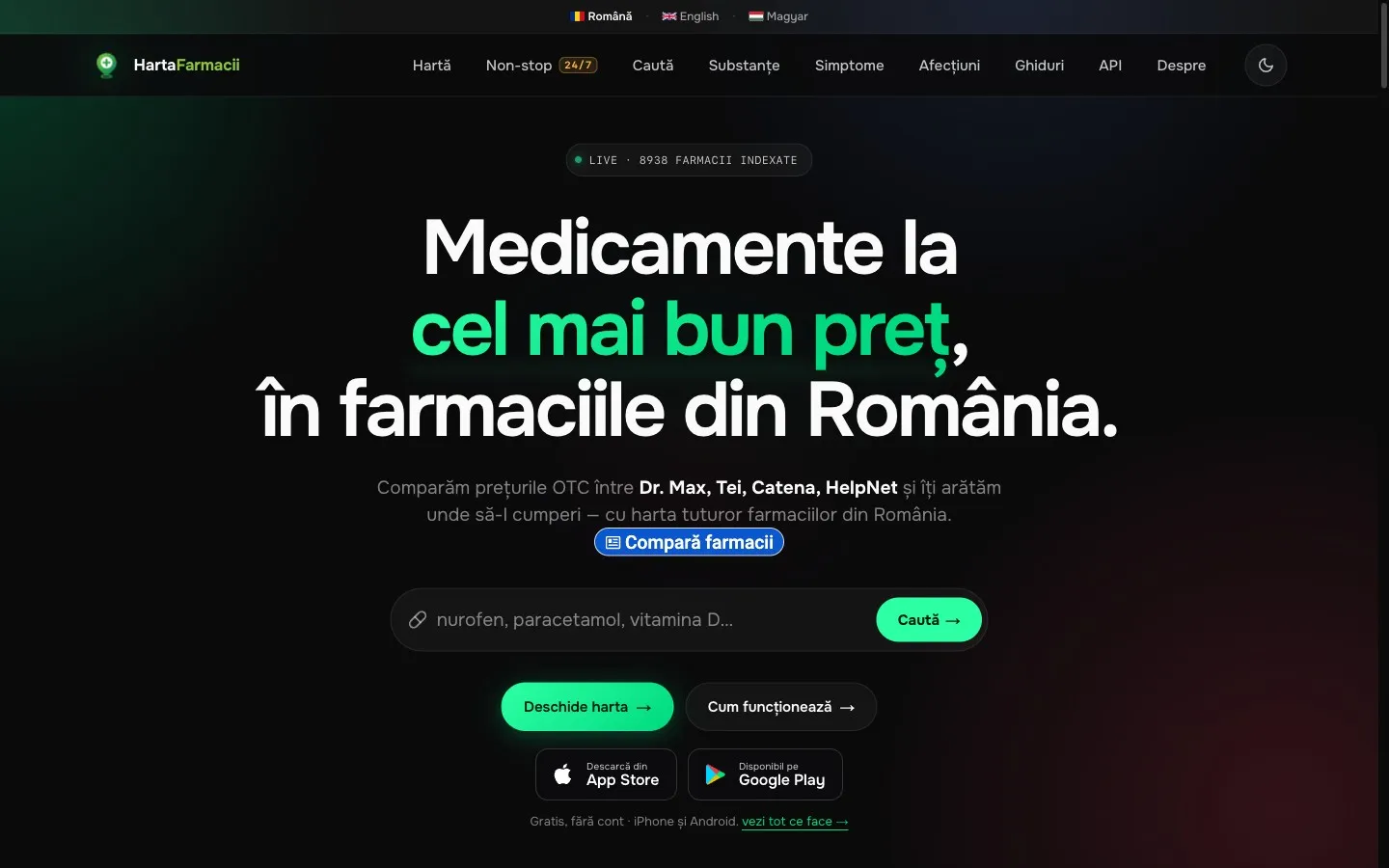
HartaFarmacii is our native example: Kotlin with Jetpack Compose and MapLibre maps, live on Google Play. It puts 8,937 pharmacies and 3,990 medical places on a map, shows opening hours and which pharmacies are on duty or open 24/7, and compares prices across pharmacy chains for 85,568 products with a live price. The Android app alone has 846 automated tests, next to 4,524 on the backend.
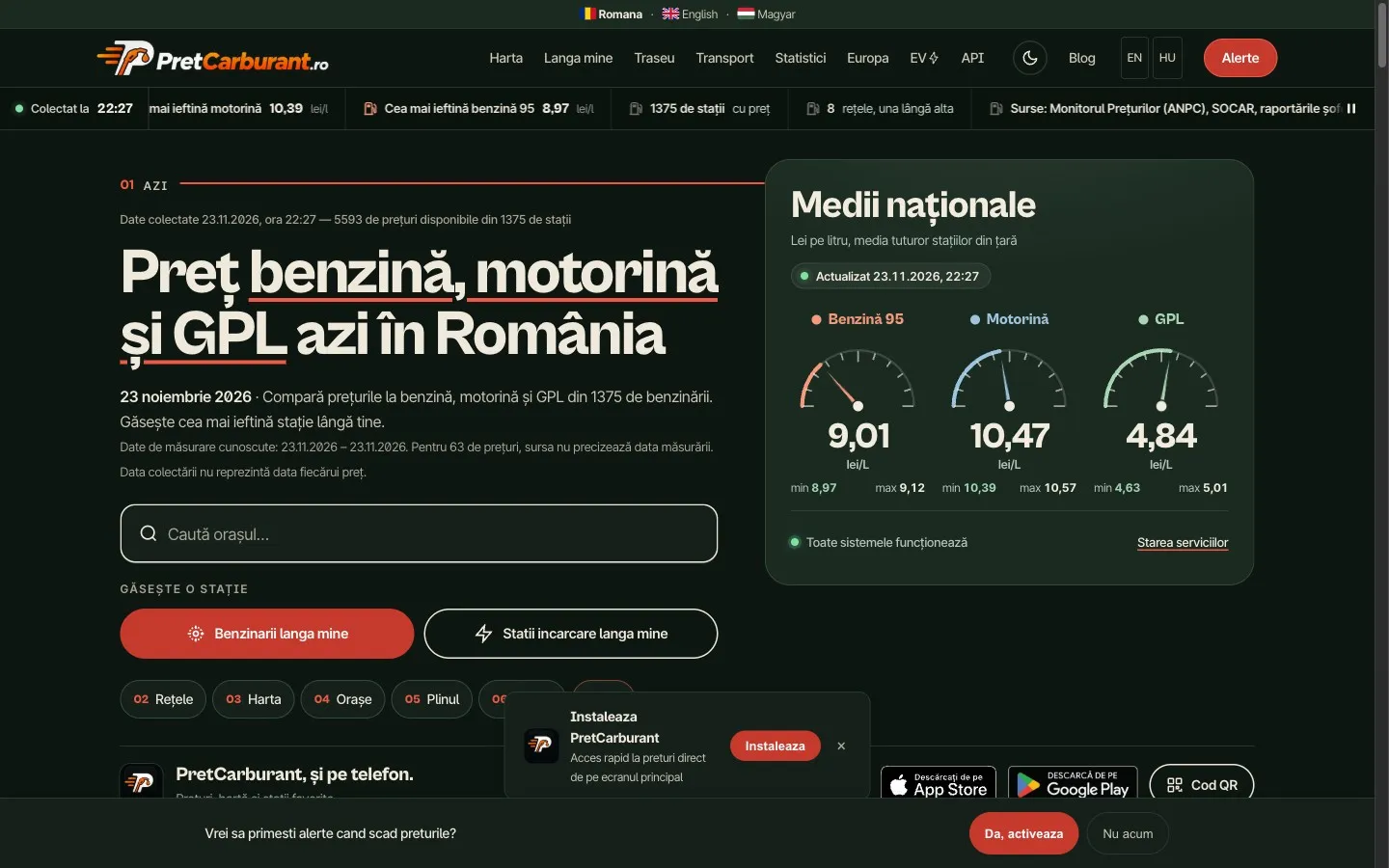
PretCarburant is our cross-platform example: React Native, Expo and MapLibre, also live on Google Play. It covers petrol, diesel and LPG prices at stations in six countries, about 1,500 of them in Romania, refreshed every 2 hours, with price-drop alerts, driver-reported prices and a trip-cost calculator. Both apps run in Romanian, English and Hungarian.
Two apps, two ways of building them, one store. We compare the two approaches on our React Native app development page.
It begins with a free initial analysis, where we ask who will use the app and on what phones, what data it shows and where it comes from, whether it needs maps, accounts or alerts, and whether an iPhone version is planned. The answers settle the choice between Kotlin and React Native, and they let us set a fixed price for the whole project before any work starts.
We then design the screens and build the app with its automated tests. To publish on Google Play, an app needs more than code: a store listing with texts and screenshots, a content rating, a declaration of the data it collects and a privacy policy. We prepare the listing and handle the submission, as we do for our own apps.
Once the final payment is made, the source code belongs to you. Monthly maintenance is optional, and on Android it has a practical reason: Google Play regularly raises the Android version that new releases must target, so an app nobody touches will eventually be unable to ship an update.
Our pricing page explains what makes an app cost more or less, and which costs come from Google rather than from development.
Kotlin is the language Google recommends for Android, and Jetpack Compose is Google’s current toolkit for Android interfaces. In Compose, each screen is written as a function of the data it shows. That suits apps where a price or an opening hour can change while the screen is open, and makes each screen easier to test.
A native Kotlin app talks to Android directly, with no layer in between. That pays off when Android is the only platform you plan to support, or when the app asks a lot of the phone. Both of our Android apps draw their maps with MapLibre, an open-source library covered under map and location-based apps.
When the app must reach iPhones too and is mostly screens of data, we use React Native with Expo. When the iPhone deserves a native app, we write it in SwiftUI, as described under iOS app development. The app’s data comes from an API, and ours are written in Python with Flask.
Companies with a website or web platform that need an Android app on top of it. Businesses with many locations, prices or products, where customers must find the answer fast. Teams that want the price fixed before work starts and code they own at the end.
If you are choosing an Android app development company from abroad, the facts are short: we are a VAT-registered company in Bucharest, in the European Union, and the C&S team offers you the same terms as any local client. Android is one part of our mobile app development service.
Describe your Android app on the contact page. The first step is the free initial analysis.
Updated C&S Visionary Systems team
It depends on what the app has to do, and we build both. HartaFarmacii for Android is native Kotlin with Jetpack Compose, PretCarburant for Android is React Native with Expo, and both are live on Google Play. You get our recommendation after the free initial analysis.
Yes. We prepare the Google Play listing and handle the submission, as we do for our own two Android apps.
Every project has a fixed price, set after a free initial analysis of what the app must do. You know it before any work starts.
You own the source code after the final payment. Monthly maintenance after launch is optional; without it, your own developers can maintain the code.
Yes. PretCarburant and HartaFarmacii each have an iOS app written in SwiftUI, built by the C&S team.
Tell us about it. The first analysis is free and you get a fixed price before any work starts.
Start a project